Swatch card No. SW-1297 · cut October 14, 2026
Trade & TariffsMill spec card
San Pedro Bay Ports Set Combined Record: 2.04 Million TEUs in September
LA and Long Beach handled 2.04 million TEUs in September, a combined record, as importers rerouted around canal disruptions. Vietnam is now the No. 2 partner at both ports.
- Fiber
- Trade & Tariffs
- Count
- 3 min read
- Cut
- Weight
- 671 words
Spec notes
- Los Angeles and Long Beach moved a combined 2.04 million TEUs in September, the busiest month in the gateway's history.
- Combined loaded imports reached 1,055,086 TEUs, up 24 percent year over year.
- China's share of U.S. imports fell from 21 percent in 2017 to 9 percent in 2025, though Chinese value added has barely moved, per Willy Shih.
- California diesel averaged $7.87 a gallon as of Friday, up 62 percent since late February.
- Seroka projects about 900,000 TEUs at Los Angeles in October, up 6.1 percent from 848,424 TEUs a year earlier.
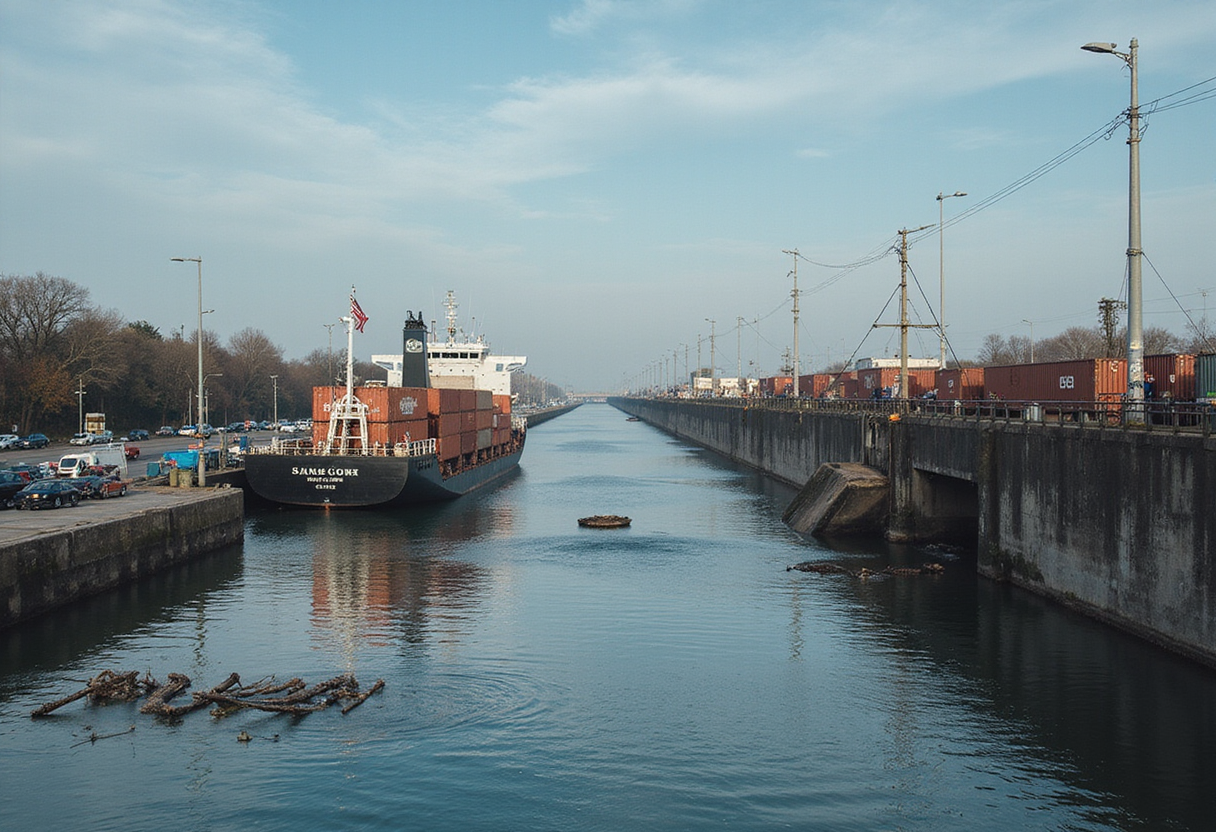
The adjacent ports of Los Angeles and Long Beach handled 2.04 million TEUs in September, the busiest month in the combined history of the San Pedro Bay gateway, as importers gained tariff-related cost certainty and rerouted cargo around disruptions at the Panama and Suez Canals.
The Port of Los Angeles moved 1,042,652 TEUs, its strongest month in 118 years and more than 20,000 units above the previous record set in July 2025. Loaded imports reached 545,696 TEUs, up 18.6 percent year over year — the tenth time the port has exceeded 500,000 loaded imports in a single month.
Long Beach posted 997,177 TEUs, beating its October 2024 record of 987,191 TEUs and rising 25 percent from 797,537 TEUs in September 2025. Combined, loaded imports across the twin ports totaled 1,055,086 TEUs, up 24 percent.
What drove the record?
Executive director Gene Seroka attributed the surge to converging forces: tariffs running lower than earlier in the year, resilient consumer demand, and cargo allocated to Los Angeles at origin as shippers navigate what he called "continued challenges along other global trade routes."
In August, Seroka projected canal congestion and Middle East uncertainty could divert an additional 5 percent of volumes to Los Angeles. He has since revised that estimate upward, saying "it's probably going to be a little bit more than that."
Meetings with shipping lines, 3PLs and manufacturers in South Korea and Singapore confirmed carriers are shifting "even more of their traditional allocation that would normally go through the canals" to Los Angeles, Seroka said at a media briefing Friday. Vessel fuel prices have doubled in eight months amid the conflict in Iran, making shorter transits a bigger priority.
How is the sourcing map shifting?
Vietnam is now the No. 2 trading partner at both ports. Vietnam-to-LA volumes have quadrupled over the past decade, and Thailand entered the port's top five origin countries for the first time. At Long Beach, furniture, apparel and footwear lead Vietnam flows, while China's share of that port's cargo fell from 70 percent six years ago to 55 percent last year.
Through September, Long Beach has handled 7,675,255 TEUs, up 3.9 percent year over year; Los Angeles is near 8.1 million containers, up more than 3 percent.
Harvard Business School professor Willy Shih, who joined the briefing, cautioned against declaring the China era over. China's direct share of U.S. imports fell from 21 percent in 2017 to 9 percent in 2025, but the share of Chinese value added has "barely moved," he said, with Vietnamese and Mexican products still reliant on Chinese intermediate goods.
"Companies, in some sense, are rearranging the final assembly step while the upstream dependence remains," Shih said. "It's not necessarily transshipment, because what we're seeing is the assembly processes are moving and they're shipping in components."
The shift follows the Trump-Xi meeting, after which both governments agreed to scale back tariffs on $30 billion in imports. Shih noted the old annual planning calendar has broken down: "Until our leaders get together and get some stability, we're just going to have to be in an environment where people are planning contingencies and creating options."
What costs sit downstream?
Diesel presents a growing pressure point. California's average diesel price hit $7.87 a gallon as of Friday, up 62 percent since late February. Two-thirds of the port's cargo leaves by truck, and more than half of registered truckers run five rigs or fewer — operators who cannot easily absorb the increase.
"If you're a small business competing with larger companies that can absorb some of this shock, that's a tough spot to be in," Seroka said.
Looking ahead, Seroka expects Los Angeles to process around 900,000 TEUs in October, a 6.1 percent increase over last year's 848,424 TEUs, with most holiday merchandise in the country by early November.
via Sourcing Journal (Source)
More from Elena Vasquez
Show full bio
News editor covering money, funding and market shifts around fashion industry as a trade and business at The Fabric Brief.
217 articles
Also on the board
- US Port Imports Track Toward 2 Million TEU Dip in November
- US Trade Deficit Hits 17-Month High of $105.6B in August
- India–US Container Rates Hit $11,000 as Capacity Cuts Bite
- Panama Canal Adds Transit Slots and Raises Draft as Water Levels Recover
- Latin America's Nearshoring Pitch: What's at Stake for Apparel Sourcers