Swatch card No. SW-5648 · cut November 18, 2026
Textile InnovationMill spec card
YKK's Motorised Zippilot Joins Five-Metre Membrane in 40 Seconds
YKK's motorised Zippilot joined a five-metre membrane in 40 seconds in Taiyo Kogyo trials and debuts at CES 2027, targeting industrial textile assembly.
- Fiber
- Textile Innovation
- Count
- 3 min read
- Cut
- Weight
- 544 words
Spec notes
- YKK's Zippilot joined a five-metre-high membrane structure in approximately 40 seconds in Japan trials.
- Two temporary shelters were connected in around 50 seconds, including a hard-to-reach roof section.
- Public demonstration scheduled at CES 2027 in Las Vegas, January 6-9.
- Trials conducted with membrane-structure specialist Taiyo Kogyo.
- No commercial garment product or launch timeline announced.
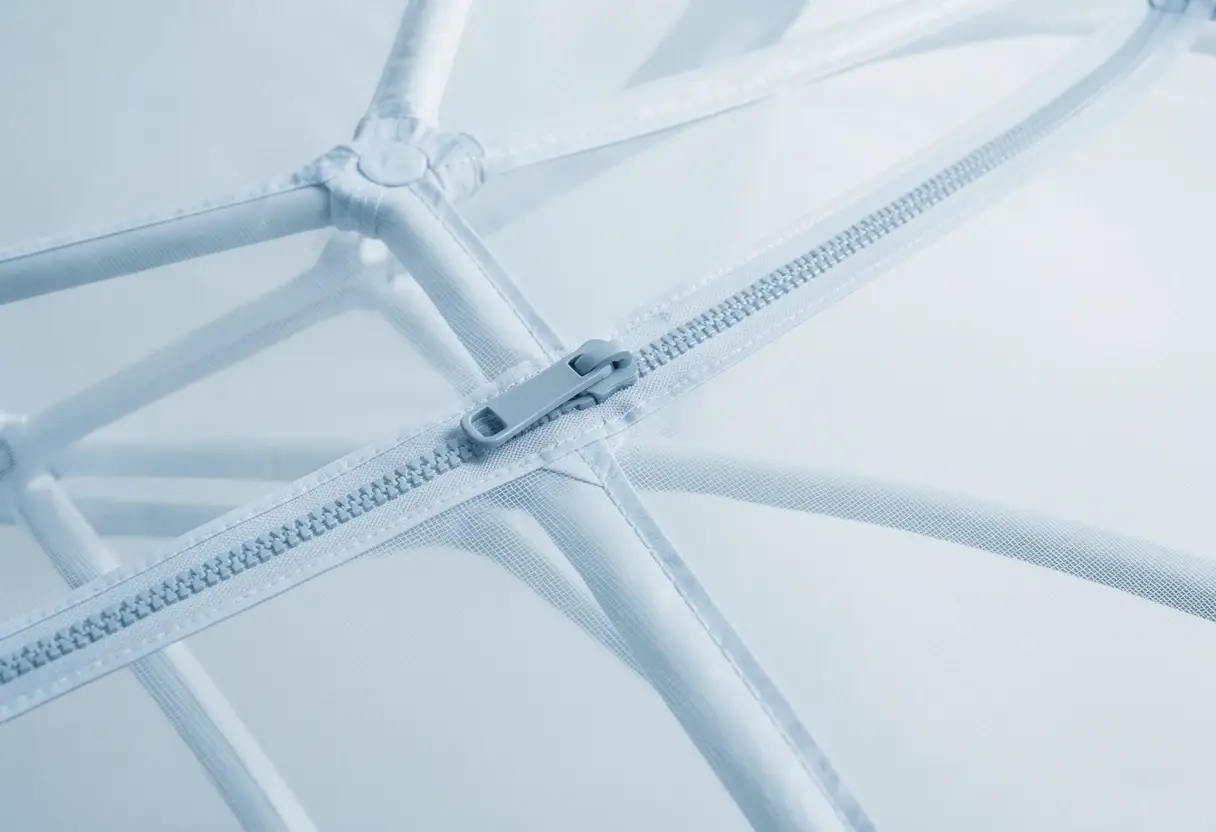
YKK has developed a self-propelled zipper, Zippilot, that joined a five-metre-high membrane structure in approximately 40 seconds in trials in Japan, and the company will demonstrate the technology at CES 2027 in Las Vegas from January 6 to 9.
The mechanism replaces the conventional hand-operated slider with a motorised unit that travels along the fastening system to open or close it. YKK tested the concept with Taiyo Kogyo, a Japanese specialist in membrane structures, and reported encouraging results.
For sourcing and technical textile professionals, the immediate relevance is not apparel. The near-term opportunity lies in industrial textiles: temporary shelters, architectural membranes and modular fabric constructions where large panels must be repeatedly joined and separated.
What did the trials demonstrate?
In one demonstration, Zippilot closed a five-metre-high membrane seam in roughly 40 seconds. In a second, two temporary shelters were connected in around 50 seconds, including a roof section that workers would otherwise have struggled to reach from the ground.
That second result carries the commercial weight. Large textile structures routinely require crews to access elevated or awkwardly positioned seams with ladders, platforms or other access equipment. A slider that moves itself along the chain reduces work at height, cuts assembly and dismantling time, and removes a compliance exposure that comes with any elevated manual task.
YKK identifies further candidate applications in exhibition installations, event structures, emergency shelters and protective covers or enclosures where access to the fastening system is restricted. Each use case shares one economics: repeated join-and-separate cycles where labour time and safe access dominate cost.
What else will YKK show at CES 2027?
Zippilot will sit alongside other fastening developments at the YKK presentation, all positioned as components performing functions beyond joining materials:
- Glow Coil Zipper — incorporates light as a design feature.
- Vislon Conductive Top-Stop — enables a zip to function as an electrical switch, allowing a fastening operation to activate or interrupt a circuit. YKK sees potential incorporation into smart garments, protective equipment and other textile products containing electronic systems.
- Variloom Print-to-Shape — an on-demand fabrication system.
Taken together, the lineup signals YKK's growing interest in integrating fastening technology with electronic functions and new approaches to product design. For brands and suppliers building connected or smart-textile products, a fastener that doubles as a circuit switch is a component decision, not a novelty: it changes how garment-level electronics are architected and who supplies them.
Is a commercial product coming?
No timeline has been announced. YKK has not confirmed a commercial garment product incorporating Zippilot. Adaptive clothing — garments for people with limited dexterity or mobility — is one possible longer-term application, but that remains a stated possibility rather than a launch.
Buyers should treat the Taiyo Kogyo results as measured demonstrations, not certified field performance. YKK has not disclosed the mechanism's duty cycle, power source, weather resistance or cost, all of which will determine whether Zippilot moves from exhibition floor to specification sheets in temporary-structure and membrane projects.
CES 2027, running January 6-9 in Las Vegas, will provide the first public demonstration of the technology outside Japan.
Whether Zippilot graduates to industrial deployment will depend on the durability and cost data YKK releases after the show.
via ykk.com (Original)
More from Elena Vasquez
Show full bio
News editor covering money, funding and market shifts around fashion industry as a trade and business at The Fabric Brief.
338 articles