Swatch card No. SW-1659 · cut September 28, 2026
Supply Chain & SourcingMill spec card
China's Cotton Price Floor Reshapes Global Apparel Sourcing
China's state-supported cotton price floor is pushing up yarn costs for Chinese mills, prompting brands to re-cost cotton-heavy programs and reallocate volume across Asian suppliers.
- Fiber
- Supply Chain & Sourcing
- Count
- 2 min read
- Cut
- Weight
- 457 words
Spec notes
- China's cotton price floor sets domestic raw-material costs above international benchmarks for Chinese spinners.
- The cost premium is prompting brands to re-evaluate allocations for cotton-intensive programs across Asian supplier bases.
- Commercial cost pressure from the floor compounds existing compliance-driven diversification away from Chinese cotton.
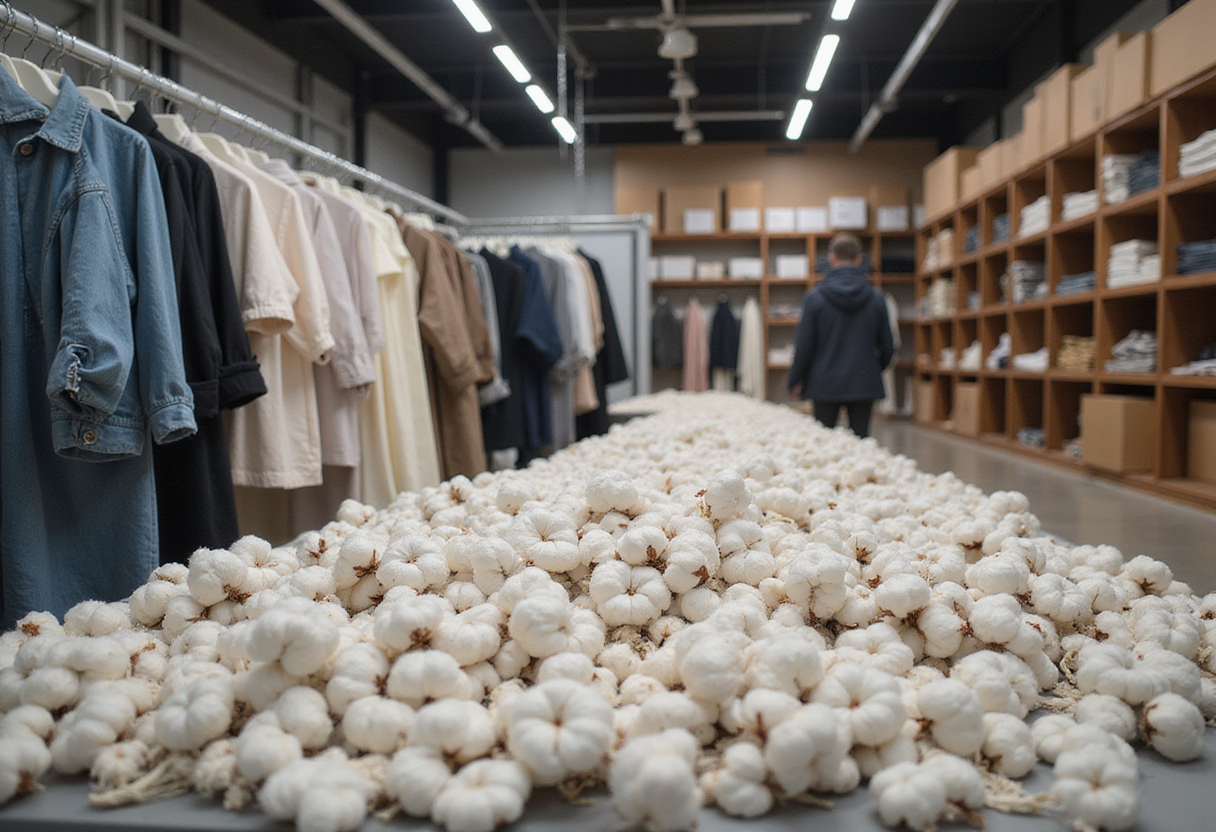
China's cotton price floor is reshaping apparel sourcing, according to a new analysis from Fibre2Fashion — a signal that raw-material policy in the world's largest textile producing country is now a direct input into brand costing and country-of-origin decisions.
The report centers on the mechanism by which Beijing supports a minimum price level for domestic cotton. That floor changes the arithmetic for spinners and mills across China's main producing and processing hubs. When the state-anchored domestic price sits above international benchmarks, Chinese yarn makers pay more for their core input than competitors buying freely on the world market.
For sourcing teams, the consequence is straightforward. Chinese cotton yarn carries a cost premium relative to yarn spun in Vietnam, Pakistan, India or Indonesia from imported fiber. That premium shows up in fabric quotes, and eventually in FOB prices on garment programs. Buyers who source cotton-heavy goods — denim, knitwear, jersey, terry — see the effect first and most sharply.
The dynamic pushes sourcing decisions in two directions at once. Some brands shift cotton-intensive programs to suppliers outside China that can use competitively priced imported cotton. Others stay with Chinese mills for their speed, vertical integration and compliance infrastructure, and absorb or negotiate away part of the cost gap. The result is a more fragmented allocation of cotton-goods volume across the Asian supplier base.
Chinese mills themselves face the squeeze most directly. Their raw-material cost is effectively set by policy rather than the global market. How each mill responds — re-engineering fabric blends, shifting to synthetic and man-made fiber programs, pursuing efficiency gains, or passing costs through — determines whether it keeps cotton orders or cedes them to regional rivals.
The price floor also intersects with the compliance picture that already complicates Chinese cotton. Brands mapping their supply chains for forced-labor risk and traceability requirements have been reducing exposure to cotton of uncertain origin. A policy-driven cost premium adds a commercial reason on top of a compliance reason to diversify. For many buyers, the two pressures reinforce each other.
Sourcing managers reviewing this landscape should treat the price floor as a structural factor, not a seasonal fluctuation. It affects comparability between quotes from different countries, the reliability of Chinese mills' cotton pricing over a season, and the risk calculations behind any concentration of volume in a single origin.
The Fibre2Fashion analysis frames the shift as ongoing rather than complete. Buyers, mills and trading houses will be watching whether the floor moves, how the gap between domestic and international prices evolves, and whether Chinese suppliers can offset the disadvantage through mix, efficiency or margin. Those variables will decide how much cotton apparel sourcing China retains — and how much migrates elsewhere.
via Google News: Apparel sourcing & supply chain (Source)
More from Marcus Bennett
Show full bio
Senior reporter covering business strategy at The Fabric Brief.
60 articles
Also on the board
- China's Cotton Price Floor Is Redrawing Apparel Sourcing Maps
- China apparel sourcing reliance eases, but the country stays central in 2026
- Chinese Mills Pitch Value-Added Innovation and CSR at Texworld
- India Positioned to Capture Apparel Sourcing Shift Away from China: Report
- US-China $30 bn Tariff Thaw Leaves Textiles Out in the Cold